Why Trikonam? The Geometry of Strength, Balance and Creation
How a simple triangle became a symbol of our devotion, our practice, and the way we experience yoga.
A personal reflection on why we chose the name Trikonam — from seeing triangles everywhere in the ashram to discovering their deeper significance in yoga, yantras and the geometry of creation.
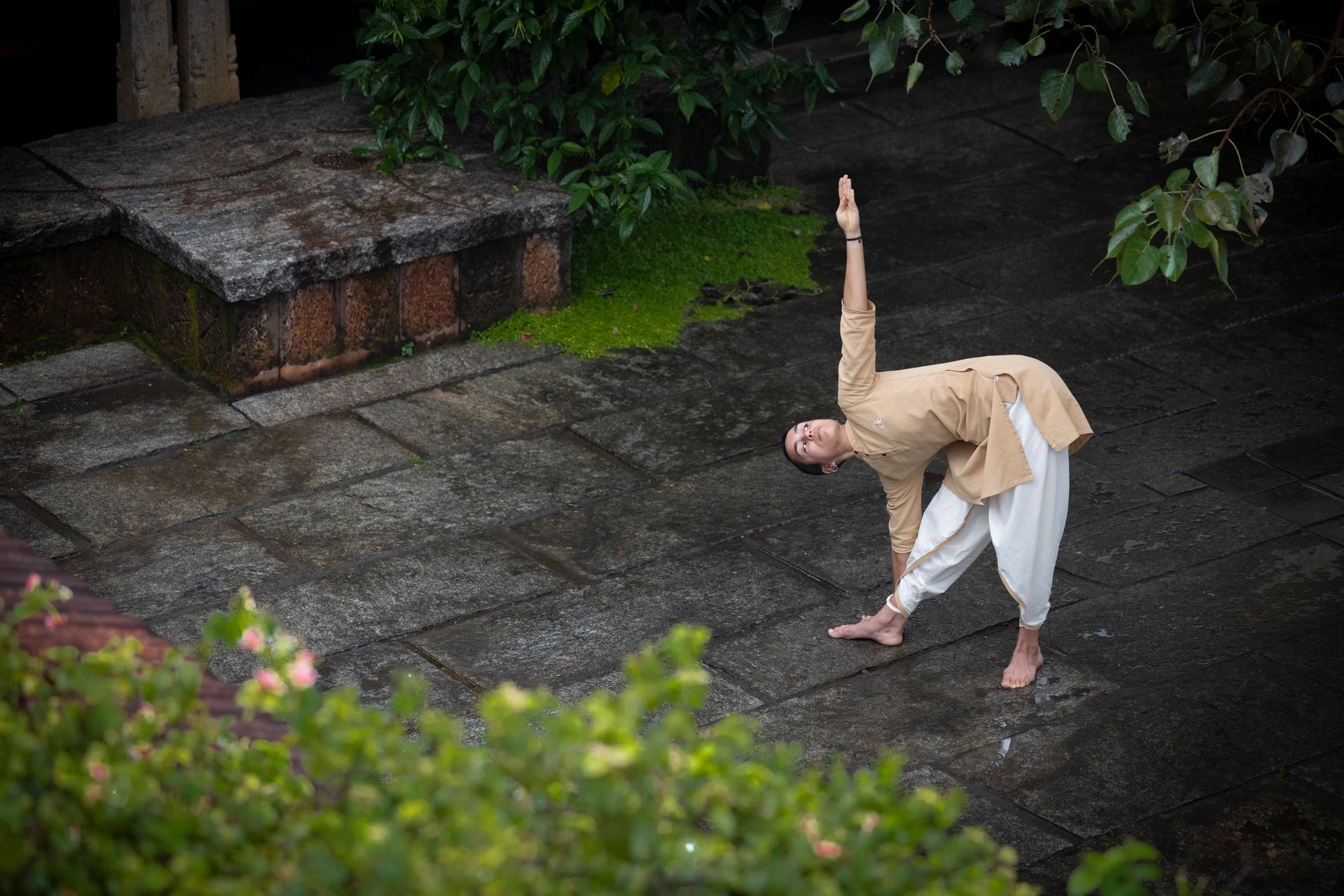
Why Trikonam?
One day, as I was walking through the ashram, I started noticing triangles everywhere.
The Devi Temple. People doing Hatha Yoga. Someone simply sitting in meditation. The walls, the roads, the spaces around me — somehow, everything seemed to take the shape of a triangle.
A friend of mine had also taken a few pictures of me while I was doing asanas. When I looked at those photographs later, I noticed triangles everywhere there too.
It made me curious about this form. And somehow, I felt very connected to it.
There was something about the triangle that felt very stable to me. It seemed to represent a certain strength and balance.
I have also always felt deeply connected to Devi. When I looked at her yantra, I saw so many triangles within it. So, when we were thinking about what to name our offerings as a team, the name Trikonam immediately came to my mind.
I suggested it to everyone and asked if they were okay with the name. All of us immediately agreed.
And that is how Trikonam came to be.
For us, it represents our devotion to Devi, but also the strength and balance that we have seen and experienced within ourselves as we began walking this path of yoga.
What Does Trikona Mean? Why Are Triangles Significant in Yoga and Yantras? What Does This Have to Do With the Human Body?
To understand the geometry of a triangle a little more deeply, let us first look at the word itself.
Trikona means a triangle — a three-pointed form.
The triangle represents many things in our existence. In many ways, it is one of the most fundamental forms of creation and one of the most integrated forms of geometry.
Sadhguru says:
The hand of the creator also chose a triangle to build the basic form within and outside us. If we observe the molecular structure, it is a complex assembly of triangles. All the yantras also have the triangle as the basic form. And the first form of yantra is a triangle.
When we begin looking at existence through this geometry, the triangle appears in many places.
In the human energy body, the nadis — the energy pathways — converge in triangular formations to create chakras. The energy system itself involves an interplay of upward-pointing and downward-pointing triangles.
When we say yantra, it means a machine.
And the most sophisticated machine on the planet is the human body.
This is where the practice of asanas becomes much more than simply working the muscles or making the body more flexible.
We do asanas to bring the geometry of our body into alignment with the cosmic geometry. Every posture has its own alignment, and when the alignment is right, the energy within us can flow in a certain way. The body becomes more aligned and receptive to what nature has to offer.
In a similar way, Trikonasana itself means a triangle posture.
Yogasanas are subtle mechanisms to manipulate life energies rather than simply being physical exercises or muscle workouts. If you hold a posture correctly, and your alignment is right, it matches with the cosmic alignment in some way.
The 84 yogasanas represent 84 alignments, because existence, as we know it now, is seen as the 84th creation. The memory of these 84 creations is reflected in our body.
Perhaps this is why the triangle kept appearing to me.
At first, I simply noticed it. Then I became curious about it.
And eventually, I understood that it was not just a shape I was drawn to. It held a deeper significance — one that connected the geometry of creation, the human body, yoga, Devi, and the very way we experience ourselves.
And somewhere along that journey, the name Trikonam felt just right.

Written by
Chandana
Classical Hatha Yoga Teacher
Chandana is a Classical Hatha Yoga teacher trained at Sadhguru Gurukulam, Isha Foundation. Through the Trikonam Journal, she shares reflections, experiences, and observations from her ongoing journey with yoga and life.